How AI SDRs Handle Lead Follow-Ups 24/7
Generating leads is only half the sales process. The real challenge begins after a lead enters your system.
A prospect may fill out a form, request a demo, download a resource, or send a WhatsApp message — but if your sales team takes hours to respond, the prospect may already be talking to a competitor.
This is where AI SDRs (AI Sales Development Representatives) are changing the way businesses manage lead follow-ups.
Unlike traditional sales teams that work during specific hours, AI SDRs can engage, qualify, and follow up with leads 24/7.
What Is an AI SDR?
An AI SDR is an AI-powered sales agent designed to automate repetitive parts of the sales development process.
It can handle tasks such as:
- Responding to new leads instantly
- Asking qualification questions
- Following up with prospects
- Answering common questions
- Identifying buying intent
- Scheduling meetings
- Updating CRM records
- Re-engaging inactive leads
- Handing qualified prospects to human sales representatives
Instead of replacing your sales team, an AI SDR acts as an additional layer between lead generation and human sales.
Why 24/7 Lead Follow-Up Matters
Not every prospect submits a form at 10 AM.
Someone might discover your company at midnight, during the weekend, or outside your sales team's working hours.
If the first response only happens the next morning, valuable time is lost.
An AI SDR can respond immediately after a lead enters the system.
For example:
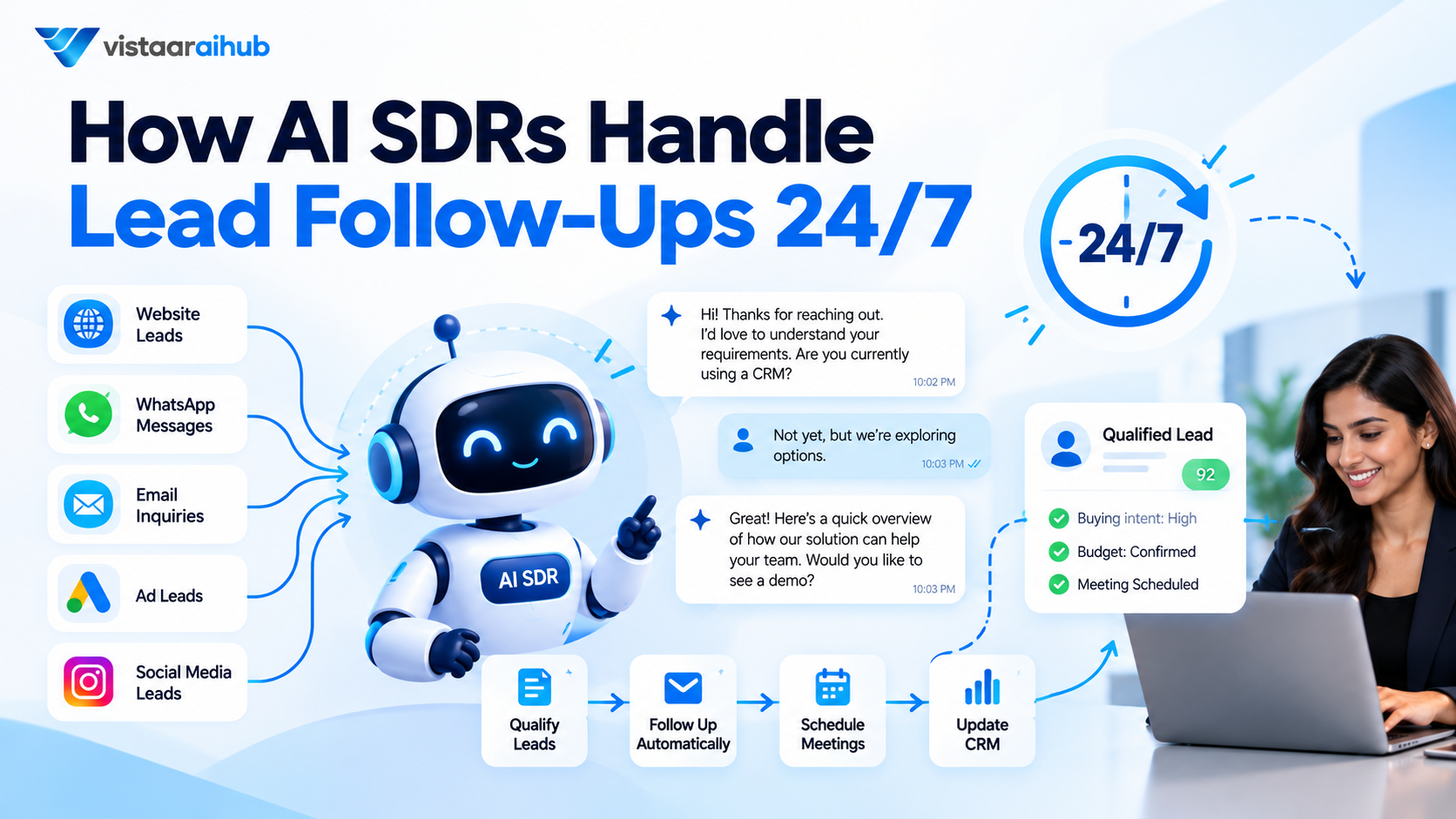
11:48 PM — Lead submits a demo request
Instead of waiting until the next working day, the AI SDR can immediately start a conversation:
"Hi Rahul, thanks for requesting a demo. I’d love to understand what you're looking for. Are you currently managing your leads manually or using a CRM?"
The conversation can continue without requiring a salesperson to be online.
How AI SDRs Handle Follow-Ups
1. Instant Lead Response
The first step is speed.
When a new lead enters through your website, landing page, advertisement, WhatsApp, or another channel, the AI SDR can automatically trigger a conversation.
This eliminates the need for a salesperson to manually check different platforms throughout the day.
The AI can respond within seconds instead of hours.
2. Lead Qualification
Not every lead deserves the same amount of sales attention.
An AI SDR can ask predefined or dynamically generated questions to understand:
- What the prospect needs
- Their company size
- Their budget
- Their timeline
- Their current solution
- Their specific requirements
- Their level of buying intent
Based on these responses, the AI can determine whether the lead should be passed to a sales representative.
3. Personalized Follow-Ups
Traditional automated emails often follow a fixed sequence.
AI SDRs can make follow-ups more contextual.
For example, if a prospect says:
"We're interested, but we're currently comparing different solutions."
The AI can remember that context and follow up accordingly rather than sending a generic promotional message.
A later follow-up could be:
"Hi Rahul, just checking in. You mentioned you were comparing a few solutions. Has your team decided what features are most important?"
This makes the conversation feel more relevant.
4. Multi-Step Follow-Up Sequences
Many leads don't convert after the first interaction.
They may be interested but busy.
An AI SDR can continue following up based on predefined rules.
For example:
Day 0: Instant response
Day 1: Follow-up
Day 3: Share relevant information
Day 5: Ask about requirements
Day 7: Meeting invitation
Day 14: Re-engagement message
The exact sequence can vary depending on the business and the prospect's behavior.
The important part is that the sales team doesn't have to manually remember every follow-up.
5. Lead Scoring Based on Intent
AI SDRs can also help prioritize leads.
For example:
A lead who only downloads a free ebook may have low buying intent.
A lead who asks:
"How much does your enterprise plan cost?"
may show stronger purchase intent.
The AI can use conversation signals, engagement, responses, and other available data to categorize leads.
For example:
Low Intent → Continue Nurturing
Medium Intent → Follow Up
High Intent → Send to Sales
This helps sales teams spend more time talking to prospects who are showing genuine interest.
AI SDRs Don't Just Follow Up — They Know When to Stop
One major problem with automated follow-ups is over-communication.
Nobody wants to receive the same message every two days.
AI SDRs can use conversation context to determine when a prospect is:
- Interested
- Not interested
- Busy
- Already converted
- Asking for more information
- Ready to speak with sales
- No longer responding
Instead of blindly sending messages, the AI can adjust the next action based on the conversation.
AI SDR + CRM: Keeping Everything Updated
Another major benefit is CRM automation.
Sales representatives often spend significant time updating CRM records after calls and conversations.
An AI SDR can automatically capture information such as:
- Lead details
- Conversation history
- Qualification responses
- Lead status
- Meeting information
- Follow-up status
- Buying intent
This creates a more complete picture of every prospect.
Your sales team can then open a lead profile and understand what happened before they entered the conversation.
When Should a Human Salesperson Take Over?
AI SDRs are most useful when they handle repetitive interactions while humans handle complex sales conversations.
For example:
AI SDR handles:
Lead response → Qualification → FAQs → Follow-ups → Scheduling
Human salesperson handles:
Negotiation → Complex questions → Product consultation → Enterprise discussions → Closing
This creates a hybrid sales process where AI handles speed and consistency while humans focus on relationships and revenue.
The Real Advantage of AI SDRs
The biggest advantage isn't simply that AI can send messages automatically.
It's that businesses can build a sales process where every lead gets an immediate response and no qualified prospect is forgotten.
Instead of:
Lead → CRM → Wait → Salesperson remembers → Follow-up
You can create:
Lead → Instant AI Response → Qualification → Follow-Up → Lead Scoring → Human Sales → CRM Update
That difference can have a significant impact on how efficiently a sales team operates.
Final Thoughts
Leads don't follow your business hours.
They can come in at 9 AM, 9 PM, or 2 AM.
The businesses that build systems capable of responding to prospects whenever they are ready to engage can create a more consistent sales experience.
AI SDRs make this possible by combining instant response, automated qualification, personalized follow-ups, lead nurturing, and CRM automation — 24/7.
The goal isn't to remove humans from sales.
The goal is to make sure your sales team spends less time chasing and organizing leads and more time having conversations that can actually turn into revenue.
Want to see how an AI SDR can automate your lead follow-ups? Explore Vistaar AI Hub and see how AI can engage, qualify, and nurture your leads automatically.