
You finally find the candidate.
Their experience matches the role.
Their salary expectations are within range.
They're interested in the opportunity.
You speak with them, understand their background and send their CV to the client.
Then the waiting starts.
The client says:
"We'll review the profile and get back to you."
A day passes.
Then another.
The candidate asks:
"Any update from the client?"
You message the hiring manager.
No response.
You follow up again.
Still nothing.
Meanwhile, the candidate is speaking with another company.
A few days later, the client finally responds.
They want to schedule an interview.
But now the candidate is no longer available.
The recruiter did the difficult part.
The right candidate was found.
The placement was lost somewhere between candidate submission and follow-up.
This is an important problem for recruitment agencies because sourcing candidates is only one part of the recruitment process.
What happens after the CV is submitted can determine whether the opportunity moves forward or quietly disappears.
Finding the Candidate Is Not the End of the Process
Recruitment agencies often spend significant effort finding suitable candidates.
But once a candidate has been submitted, several things still need to happen.
The client needs to:
- Review the profile
- Decide whether to interview
- Provide feedback
- Schedule an interview
- Share the next steps
The candidate needs to:
- Know whether the client responded
- Stay interested
- Remain available
- Prepare for the interview
- Understand what happens next
And the recruiter needs to coordinate both sides.
That creates a three-way communication loop:
Recruiter ↔ Client
Recruiter ↔ Candidate
Client ↔ Candidate
The recruiter often sits in the middle of everything.
When the process is managed manually, small delays can quickly become large problems.
Problem 1: The Client Has the CV, But Nobody Knows the Next Step
One of the most common situations looks like this:
CV submitted → Waiting for client
That's not really a process.
It's a status.
The recruiter still needs to know:
- When was the CV submitted?
- Who received it?
- When should the recruiter follow up?
- Has the client opened or reviewed it?
- Has the client responded?
- Is the role still active?
- Is an interview being considered?
- Is another candidate being considered?
- Does the client need more information?
Without a clear next action, the candidate can sit in this stage longer than expected.
And the longer the candidate waits, the more opportunities they may consider elsewhere.
Problem 2: Recruiters Have to Chase Client Feedback
Imagine a recruiter submits five candidates to three different clients.
Now each client has a different response time.
One responds within a few hours.
Another takes three days.
Another doesn't respond at all.
The recruiter now has to remember:
"I need to follow up with Client A today."
"Client B said they'll respond tomorrow."
"Client C hasn't replied since Monday."
This might sound manageable with a small number of vacancies.
But recruitment agencies can have dozens of active roles and hundreds of candidate submissions moving through different stages.
At that point, follow-up becomes an administrative workload of its own.
Problem 3: Candidates Don't Know What Is Happening
The client may be taking time to review a profile.
The recruiter knows this.
But the candidate doesn't.
From the candidate's perspective:
"I sent my CV three days ago. Why haven't I heard anything?"
Silence creates uncertainty.
The candidate may start thinking:
- Was my profile rejected?
- Is the company still interested?
- Did the recruiter forget about me?
- Should I continue applying elsewhere?
- Is the position still available?
Recruiters don't necessarily need to provide constant updates.
But they do need a reliable way to keep candidates informed when appropriate.
Even a simple message such as:
"Your profile is still with the client. We're waiting for their feedback and will update you as soon as we hear back."
can create a very different candidate experience.
Problem 4: The Candidate Gets Another Offer While You're Waiting
This is where the delay becomes expensive.
A candidate can be interviewing with multiple companies simultaneously.
That's normal.
Suppose:
Monday: Candidate submitted to Client A
Tuesday: Client A hasn't responded
Wednesday: Candidate interviews elsewhere
Thursday: Candidate receives another offer
Friday: Client A finally wants an interview
The recruitment agency can no longer control the candidate's availability.
The opportunity wasn't necessarily lost because the candidate wasn't suitable.
It may have been lost because the recruitment process moved too slowly.
This is why follow-up speed matters.
Not because recruiters should pressure clients or candidates, but because recruitment operates in a competitive market where circumstances change quickly.
Problem 5: Recruiters Remember Too Much in Their Heads
Recruitment is full of small details.
A recruiter might remember:
"Sarah from ABC said she wanted Java developers with five-plus years of experience."
"John isn't available until next month."
"Mike is interested but wants remote work."
"Client X promised feedback on Thursday."
When the number of candidates and clients increases, relying on memory becomes difficult.
Information may be spread across:
- Notes
- Spreadsheets
- Calendar reminders
- ATS
- CRM
- Personal task lists
The problem isn't that recruiters aren't organized.
It's that there is simply too much information moving through the process.
A good recruitment workflow should help the recruiter remember the process without having to remember everything personally.
Problem 6: One Candidate Can Be in Multiple Processes
This makes recruitment particularly complicated.
A candidate might be:
- Submitted to Company A
- Interviewing with Company B
- Waiting for feedback from Company C
- Considering another opportunity independently
At the same time, their availability can change.
Their salary expectations can change.
Their location preference can change.
Their notice period can change.
A candidate isn't simply:
Available / Not Available
Their situation is constantly moving.
This means recruitment agencies need more than a static candidate database.
They need a way to keep track of the candidate's current situation.
Problem 7: Interview Scheduling Creates Another Follow-Up Loop
Finally, the client responds:
"We'd like to interview the candidate."
Great.
But now another process begins.
The recruiter needs to:
- Contact the candidate.
- Check availability.
- Contact the client.
- Confirm a time.
- Send the details.
- Remind the candidate.
- Remind the client if necessary.
- Handle rescheduling.
- Confirm attendance.
One interview might be simple.
Multiply that across multiple candidates and vacancies, and scheduling becomes a significant administrative task.
This is an area where workflow automation can be particularly practical.
The Real Problem: The Gap Between Each Stage
Recruitment agencies often focus heavily on individual stages:
Sourcing
Screening
Interviewing
Placement
But problems frequently occur between those stages.
For example:
Candidate found
↓
Candidate submitted
↓
?
↓
Client feedback
↓
?
↓
Interview
↓
?
↓
Placement
Those question marks represent the operational gaps.
Who follows up?
When?
What happens if there is no response?
Who informs the candidate?
What happens if the interview is delayed?
What happens if the client changes the requirement?
Those are workflow problems.
What a Better Candidate Submission Workflow Looks Like
A more structured process could look like this:

The important difference is that "waiting" becomes an actual workflow stage.
The system knows:
- What happened
- When it happened
- What should happen next
- Who owns the next action
Automation Doesn't Mean Sending More Messages
When people hear "recruitment automation," they often think about automated emails.
But that's only one small part.
Automation can simply mean making sure the next action doesn't get forgotten.
For example:
Instead of:
Recruiter remembers to follow up.
Use:
Candidate submitted → follow-up task automatically created.
Instead of:
Recruiter manually checks whether the client replied.
Use:
Workflow flags submissions that have been waiting beyond the defined follow-up period.
Instead of:
Candidate repeatedly asks for an update.
Use:
Candidate receives an appropriate status update when the workflow reaches a relevant stage.
The objective is not more automation.
The objective is fewer unnecessary gaps.
What Should Recruitment Agencies Automate?
Not everything needs automation.
Start with repetitive coordination tasks.
Candidate submission tracking
Record when a candidate was submitted and to which client.
Client follow-up reminders
Create the next action automatically.
Interview reminders
Send appropriate reminders before scheduled interviews.
Candidate status updates
Keep candidates informed when a meaningful status change occurs.
Internal notifications
Alert the right recruiter when action is required.
Data updates
Keep candidate and submission records current where reliable rules exist.
Re-engagement
Identify candidates who may need to be contacted again after a defined period.
These workflows can reduce administrative work without removing the recruiter from the process.
Where AI Can Help
AI can be useful when recruiters are dealing with large amounts of unstructured information.
For example, a client might write:
"The candidate looks good overall, but we need someone who has managed a team of at least 10 people and preferably has experience in fintech."
Instead of manually turning that message into notes, AI can potentially help summarize the feedback.
The recruiter might then see:
Client feedback:
- Candidate generally suitable
- Team management experience required
- Minimum team size: 10
- Fintech experience preferred
The recruiter can review the information and decide what to do next.
AI can also help summarize conversations, extract requirements and organize information.
But the recruiter should remain in control of important decisions.
Don't Automate the Relationship
There is a temptation to automate every message.
That's not necessarily a good idea.
A candidate who has just been rejected from an important opportunity may need a thoughtful human conversation.
A client with a difficult hiring requirement may need a recruiter who understands the situation.
A senior candidate considering a career move may not want to communicate with an automated system at every stage.
Automation should handle the coordination.
Recruiters should handle the relationship.
That's a much healthier way to approach recruitment automation.
A Simple Example
Consider an agency recruiting for a software company.
The client needs:
5 backend developers
The recruiter finds:
12 potential candidates
After screening:
5 candidates are submitted
Now imagine the manual process.
The recruiter has to remember:
- When each CV was sent
- Who received it
- When to follow up
- Which candidates are still interested
- Who has another interview
- Who is available
- Which client feedback has arrived
- Which interviews are scheduled
Now compare that with a structured workflow.
Candidate 1
Submitted → Waiting for feedback
Candidate 2
Interview scheduled → Tuesday 3 PM
Candidate 3
Client requested additional information
Candidate 4
Client rejected → Candidate can be considered for another role
Candidate 5
Client interested → Final interview
The recruiter can immediately see what needs attention.
That's the real value of workflow automation.
Not replacing the recruiter.
Reducing the amount of information the recruiter has to hold in their head.
The Recruitment Agency Efficiency Problem
Recruitment agencies often measure their success through placements.
But there are several activities before a placement that determine whether the placement happens.
For example:
Candidate sourcing
↓
Screening
↓
Submission
↓
Client response
↓
Interview
↓
Feedback
↓
Offer
↓
Placement
A delay at any point can affect the final outcome.
That means improving recruitment isn't always about finding more candidates.
Sometimes it is about moving suitable candidates through the existing process more efficiently.
How to Find Your Biggest Follow-Up Bottleneck
Before buying recruitment automation software, look at your last 20–50 candidate submissions.
For each one, ask:
How long did the client take to respond?
How many times did the recruiter follow up?
How long did it take to schedule the interview?
Did the candidate receive regular updates?
Did the candidate remain available?
Where did the process stop?
You may discover that your biggest problem isn't sourcing.
It could be:
- Client response time
- Interview scheduling
- Candidate communication
- Internal follow-up
- Data management
- Lack of visibility
Once you know the bottleneck, you can automate the right part.
A Practical Recruitment Automation Starting Point
You don't need to automate the whole recruitment operation.
Start with one workflow.
For example:
Step 1 — Record the submission
When a candidate is submitted, record:
- Candidate
- Client
- Role
- Submission date
- Recruiter
- Current status
Step 2 — Create the next action
Don't leave the submission sitting in "waiting."
Create a defined follow-up point.
Step 3 — Track client response
When feedback arrives, update the submission.
Step 4 — Update the candidate
Keep the candidate informed where appropriate.
Step 5 — Move to the next stage
Interview, rejection, additional information, offer or another action.
This simple workflow can already remove a surprising amount of manual coordination.
What Recruitment Automation Should Ultimately Achieve
The goal isn't:
"Automate recruitment."
That's too broad.
A better goal is:
Make sure no important candidate submission, client response or follow-up gets lost because someone was too busy to remember it.
That is a much more practical objective.
Recruiters should be spending their time:
- Talking to candidates
- Understanding clients
- Finding the right people
- Building relationships
- Negotiating
- Closing placements
Not constantly checking:
"Did I follow up with that client?"
How VistaarAIHub Fits Into Recruitment Workflows
At VistaarAIHub, we're interested in the workflow problems that happen between the important conversations.
For recruitment agencies, that can mean helping organize processes around:
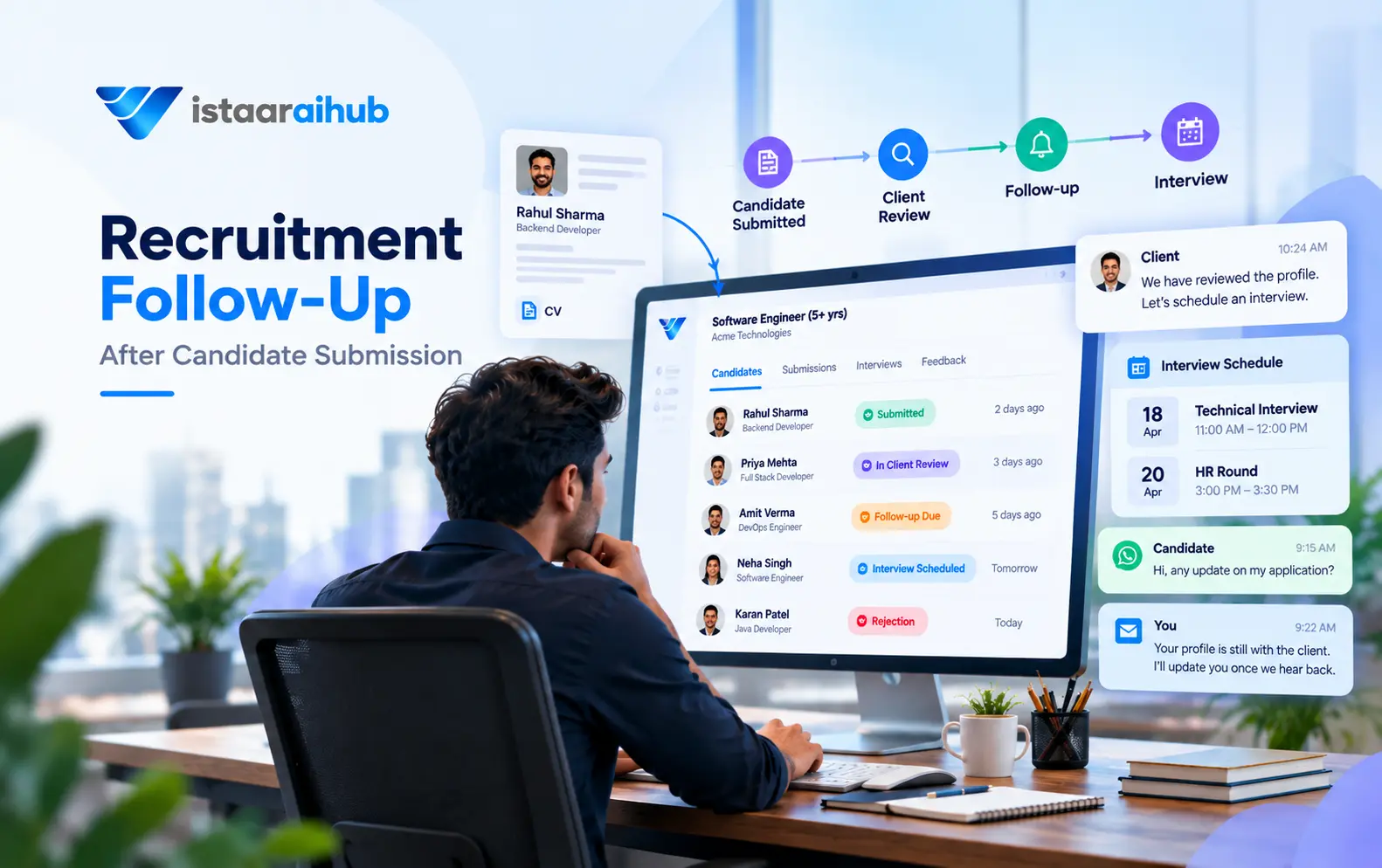
Candidate submission → Follow-up → Client response → Interview → Candidate communication → Next action
The technology should support the recruiter's workflow rather than replace the recruiter.
The agency still owns the client relationship.
The recruiter still owns the candidate relationship.
Automation simply helps make sure the operational steps between those conversations don't get forgotten.
Final Thoughts
Finding a good candidate is only half the job.
After the CV is submitted, the clock starts moving.
The client may be reviewing several candidates.
The candidate may be interviewing elsewhere.
The hiring requirement may change.
An interview may need to be rescheduled.
Feedback may be delayed.
And the recruiter may already be managing dozens of other processes.
That's why recruitment agencies need to look beyond sourcing and candidate databases.
The question isn't simply:
"How do we find more candidates?"
It is also:
"How do we make sure the right candidate doesn't get lost after we've found them?"
A well-designed workflow can help.
Not by replacing the recruiter.
Not by sending endless automated messages.
But by making sure the right person knows what happened, what needs to happen next, and when it needs to happen.
Because sometimes the difference between a successful placement and a lost candidate isn't finding a better candidate.
It's following up at the right time.