
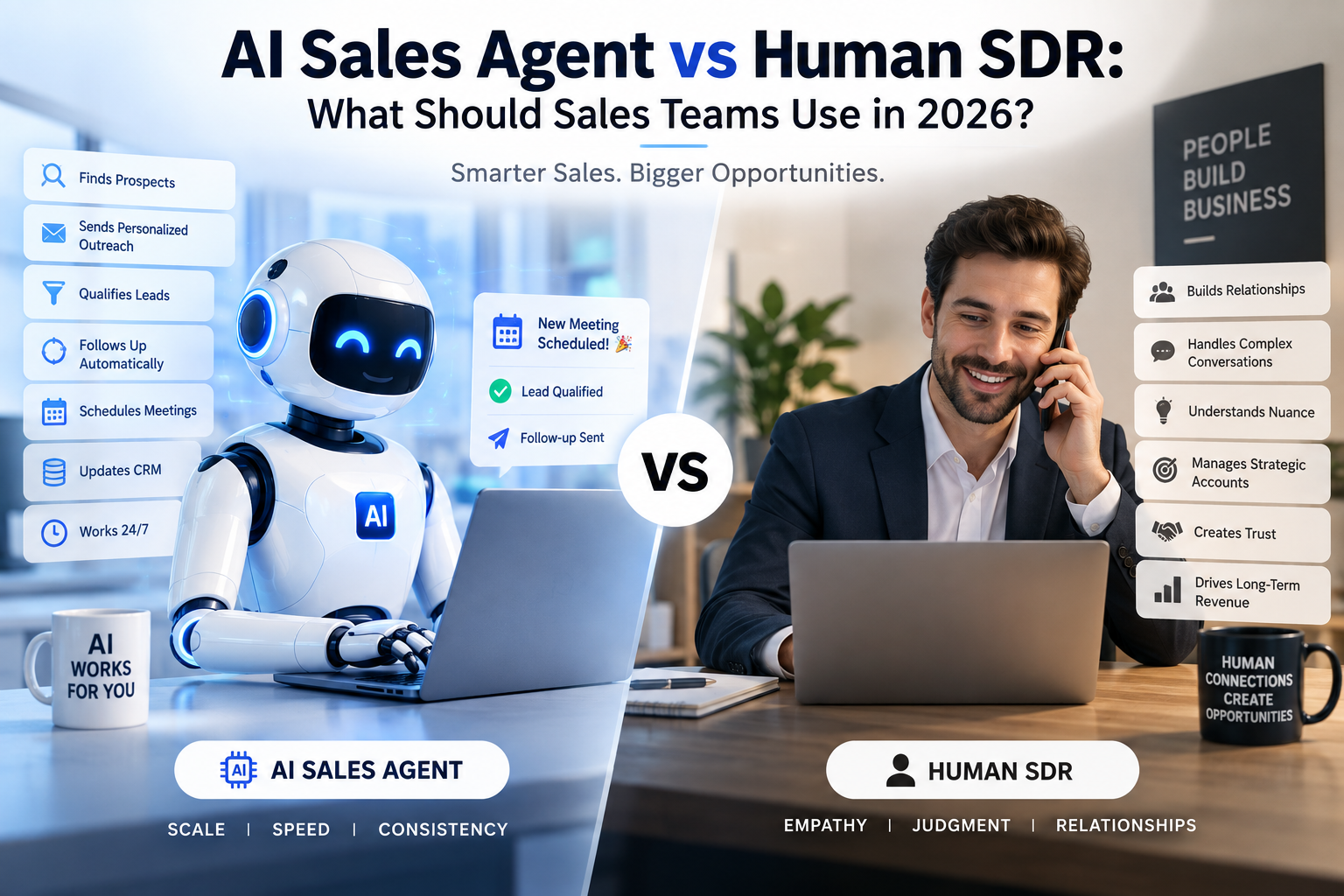
AI Sales Agent vs Human SDR: What Should Sales Teams Use in 2026?
Sales development is changing quickly.
For years, Sales Development Representatives (SDRs) have been responsible for prospecting, sending emails, qualifying leads, following up with prospects, and booking meetings for Account Executives.
But in 2026, sales teams have another option: the AI sales agent.
An AI sales agent can prospect for leads, start conversations, qualify prospects, follow up automatically, answer common questions, and schedule meetings—often without requiring a human to be involved in every interaction.
This raises an important question:
Should sales teams replace human SDRs with AI sales agents, or should they use both?
The answer isn't simply AI vs. humans.
For most sales teams in 2026, the better approach is to combine AI sales agents for repetitive, high-volume activities with human SDRs for complex conversations and relationship building.
Let's compare both approaches.
What Is an AI Sales Agent?
An AI sales agent is an AI-powered system designed to perform sales activities that traditionally require a salesperson.
Depending on the platform, an AI sales agent can handle tasks such as:
- Finding and researching prospects
- Lead qualification
- Outbound prospecting
- Email outreach
- Follow-up conversations
- Answering prospect questions
- Appointment scheduling
- Lead nurturing
- CRM updates
- Re-engaging inactive leads
- Handling inbound inquiries
- Communicating through email, chat, voice, or messaging
Unlike traditional automation that simply follows predefined rules, modern AI sales agents can understand conversations and respond based on context.
For example, if a prospect replies:
"We're interested, but we're currently using another solution. Can you explain how your platform is different?"
An AI sales agent can identify the objection, provide a relevant response, and continue the conversation rather than simply sending the next automated email.
This makes AI sales agents particularly useful for sales teams dealing with large numbers of prospects.
What Does a Human SDR Do?
A human SDR typically focuses on generating and qualifying sales opportunities before handing qualified prospects to an Account Executive.
Their responsibilities often include:
- Prospect research
- Cold calling
- Cold emailing
- Social selling
- Lead qualification
- Discovery conversations
- Follow-ups
- Handling objections
- Meeting booking
- CRM management
- Account research
The biggest advantage of a human SDR is judgment.
A human can understand subtle signals in a conversation, build rapport, recognize unusual situations, and adapt their communication based on emotions and business context.
However, human SDR teams also have limitations.
Hiring and training SDRs takes time. SDRs also have limited working hours and can spend a significant part of their day on repetitive administrative tasks.
AI Sales Agent vs Human SDR: Key Differences
| Factor | AI Sales Agent | Human SDR |
|---|---|---|
| Availability | 24/7 | Limited working hours |
| Lead volume | Very high | Limited by team size |
| Response speed | Seconds/minutes | Minutes/hours |
| Repetitive tasks | Excellent | Time-consuming |
| Personal relationships | Limited | Excellent |
| Complex conversations | Improving | Excellent |
| Lead qualification | Strong for defined criteria | Strong for complex situations |
| Scalability | Very high | Requires hiring |
| Cost per interaction | Lower at scale | Higher |
| Emotional intelligence | Limited | Strong |
| Consistency | High | Can vary |
| CRM updates | Can be automated | Often manual |
| Follow-ups | Automated | Often inconsistent |
| Strategic selling | Limited | Strong |
The key takeaway is simple:
AI sales agents and human SDRs are good at different things.
1. AI Sales Agents Win on Speed
Speed matters enormously in sales.
When someone submits a demo request or responds positively to an outbound campaign, waiting several hours—or even a day—for a salesperson to respond can make it harder to start a conversation.
An AI sales agent can respond almost immediately.
Example
Prospect:
"I'm interested in your product. Can someone show me how it works?"
AI Sales Agent:
"Absolutely. I can help you schedule a demo. Would Tuesday at 2 PM or Wednesday at 11 AM work better?"
The prospect can move directly from interest to a scheduled meeting.
A human SDR may not see the message until later.
Winner: AI Sales Agent
2. Human SDRs Win at Relationship Building
Sales isn't only about speed and efficiency.
Some deals require trust.
Enterprise buyers may want to understand:
- How the product fits their organization
- Implementation requirements
- Security considerations
- Pricing structures
- Business impact
- Internal adoption
- Competitive differences
These conversations can become complicated quickly.
A human SDR can read between the lines, ask nuanced questions, and adapt the conversation based on the prospect.
For high-value enterprise sales, this human element remains extremely important.
Winner: Human SDR
3. AI Sales Agents Can Handle More Leads
Imagine an SDR has 500 prospects to follow up with.
Even with a strong process, manually researching, contacting, following up, qualifying, and updating CRM records for every prospect can become difficult.
An AI sales agent can handle many conversations simultaneously.
Your sales capacity doesn't have to increase at the same rate as your headcount.
Instead of hiring another SDR every time lead volume increases, companies can use AI to absorb repetitive work.
Winner: AI Sales Agent
4. Human SDRs Are Better at Complex Objections
Consider these two situations.
Simple objection
"We don't have the budget right now."
An AI sales agent may be able to respond using approved messaging, identify the objection, and schedule a future follow-up.
Complex objection
"We tried a similar platform last year. Our sales team didn't adopt it because it created too many workflow changes and our compliance team rejected the data-sharing model."
That's much more complicated.
The SDR needs to understand:
- What failed previously
- Why adoption was low
- What compliance concerns exist
- Who the decision-makers are
- Whether the current product actually solves those concerns
This is where human judgment becomes extremely valuable.
Winner: Human SDR
5. AI Sales Agents Are Better at Follow-Up
One of the biggest weaknesses in traditional sales processes is inconsistent follow-up.
A prospect may say:
"Let's talk next month."
The SDR might create a reminder.
But if the reminder is missed, the opportunity can disappear.
An AI sales agent can systematically manage follow-ups based on predefined rules and conversation context.
Example Follow-Up Sequence
Day 1: Initial outreach
Day 4: Follow-up
Day 10: Share a relevant resource
Day 21: Re-engagement message
Day 30: Final follow-up
This creates a consistent sales process without requiring an SDR to remember every follow-up.
Winner: AI Sales Agent
6. AI Sales Agents Can Reduce SDR Administrative Work
SDRs don't spend all their time selling.
A significant amount of their work can involve:
- Updating CRM records
- Writing repetitive emails
- Logging activities
- Researching basic company information
- Scheduling meetings
- Creating follow-up tasks
- Sorting leads
- Updating lead stages
These tasks are necessary, but they don't necessarily require human judgment.
An AI sales agent can automate much of this operational workload.
This allows human SDRs to spend more time on activities where their skills create greater value.
Winner: AI Sales Agent
7. Human SDRs Still Matter for High-Value Accounts
Not every lead should receive the same sales process.
A $500 deal and a $500,000 enterprise opportunity shouldn't be treated identically.
For smaller or straightforward opportunities, AI can potentially manage much of the sales development process.
For strategic accounts, however, companies may want a human SDR involved much earlier.
A useful model is:
AI identifies → AI qualifies → Human engages → AE closes
This allows sales teams to combine scalability with human expertise.
Should You Replace Human SDRs With AI?
Not necessarily.
The better question is:
Which sales activities should AI handle, and which activities should humans handle?
Instead of thinking about AI sales agents as replacements for SDRs, sales teams should think about them as digital sales team members.
What Should an AI Sales Agent Handle?
An AI sales agent can handle:
- Prospecting
- Lead enrichment
- Initial outreach
- First-level qualification
- Follow-ups
- Meeting scheduling
- Basic objections
- CRM updates
- Lead nurturing
What Should a Human SDR Handle?
Human SDRs can focus on:
- Strategic accounts
- Complex objections
- Relationship building
- Personalized outreach
- Advanced qualification
- High-value prospects
- Account research
- Human-to-human conversations
This creates a more efficient sales organization.
The Hybrid Sales Team Is the Future
The strongest sales teams in 2026 may not be completely human or completely AI-driven.
Instead, they will operate as hybrid sales teams.
Imagine this workflow:
Step 1: AI Sales Agent Identifies Prospects
The AI identifies prospects that match the company's ideal customer profile.
↓
Step 2: AI Researches the Account
The AI gathers relevant information about the company, role, industry, and potential needs.
↓
Step 3: AI Sends Personalized Outreach
The AI starts the conversation using relevant messaging.
↓
Step 4: AI Handles the Initial Conversation
The AI answers basic questions and responds to common objections.
↓
Step 5: AI Qualifies the Lead
The AI determines whether the prospect meets the required qualification criteria.
↓
Step 6: Qualified Opportunity Goes to a Human SDR
The human SDR takes over when the conversation requires deeper engagement.
↓
Step 7: Human SDR Handles the Deeper Conversation
The SDR builds the relationship and understands the prospect's requirements.
↓
Step 8: Account Executive Conducts the Sales Call
The qualified opportunity is passed to the AE.
↓
Step 9: AI Handles Follow-Ups and CRM Updates
AI continues supporting the sales process after the meeting.
This approach allows each part of the sales process to be handled by the resource best suited for it.
AI Sales Agent vs Human SDR: Which Is More Cost-Effective?
Cost depends on the company's sales model, deal size, and technology stack.
A human SDR requires ongoing investment in:
- Salary
- Hiring
- Training
- Management
- Benefits
- Sales tools
- Recruitment
- Onboarding
An AI sales agent generally requires technology and platform costs rather than traditional employee compensation.
However, cost shouldn't be the only consideration.
The real metric should be:
Revenue generated per sales resource.
If AI allows one SDR to manage significantly more qualified opportunities, the economics can become much more attractive.
When Should You Use an AI Sales Agent?
An AI sales agent is particularly useful when your business:
- Has a large lead database
- Receives leads outside business hours
- Needs faster lead response
- Runs high-volume outbound campaigns
- Has repetitive qualification criteria
- Struggles with follow-up consistency
- Wants to scale without rapidly increasing headcount
- Has multiple sales channels
- Needs 24/7 customer engagement
- Wants to automate CRM and sales operations
For example, a SaaS company receiving hundreds of inbound leads every month could use an AI sales agent to immediately qualify leads and route the highest-value opportunities to human salespeople.
When Should You Use Human SDRs?
Human SDRs remain especially valuable when:
- Deals are complex
- Sales cycles are long
- Average contract value is high
- Multiple stakeholders are involved
- Prospects need significant education
- Relationship building is critical
- Objections are highly nuanced
- Strategic accounts require personalization
For these situations, completely removing humans from the sales process can create unnecessary risk.
The Best Strategy: AI + Human SDR
The real opportunity isn't choosing between AI sales agents and human SDRs.
It's designing the sales process so that each handles the work they're best at.
| Sales Activity | Best Fit |
|---|---|
| Lead research | AI |
| Lead enrichment | AI |
| High-volume prospecting | AI |
| Initial outreach | AI |
| Basic qualification | AI |
| Follow-ups | AI |
| Meeting scheduling | AI |
| CRM updates | AI |
| Complex qualification | Human |
| Strategic accounts | Human |
| Relationship building | Human |
| Complex objections | Human |
| Negotiation | Human |
| Closing | Human |
This model doesn't eliminate salespeople.
It makes salespeople more productive.
What Will SDRs Look Like in 2026?
The SDR role is likely to evolve.
Instead of spending most of their day sending repetitive emails and updating CRM records, SDRs can focus more on:
- Strategic prospecting
- Account planning
- High-value conversations
- Personalized engagement
- Opportunity development
- Relationship building
- Working with AI sales agents
In other words, the SDR may become less of a manual activity executor and more of a sales strategist and AI supervisor.
The teams that learn how to work effectively with AI could have an advantage over teams that continue relying entirely on manual processes.
Final Verdict: AI Sales Agent vs Human SDR
So, what should sales teams use in 2026?
The answer is both—but for different purposes.
An AI sales agent is ideal for:
- Speed
- Scale
- Repetitive tasks
- Lead qualification
- Follow-ups
- 24/7 engagement
A human SDR is better suited for:
- Complex conversations
- Strategic accounts
- Relationship building
- Advanced qualification
- Situations requiring judgment and empathy
The winning sales organization isn't necessarily the one with the most AI or the most SDRs.
It's the one that creates the best combination of AI efficiency and human expertise.