
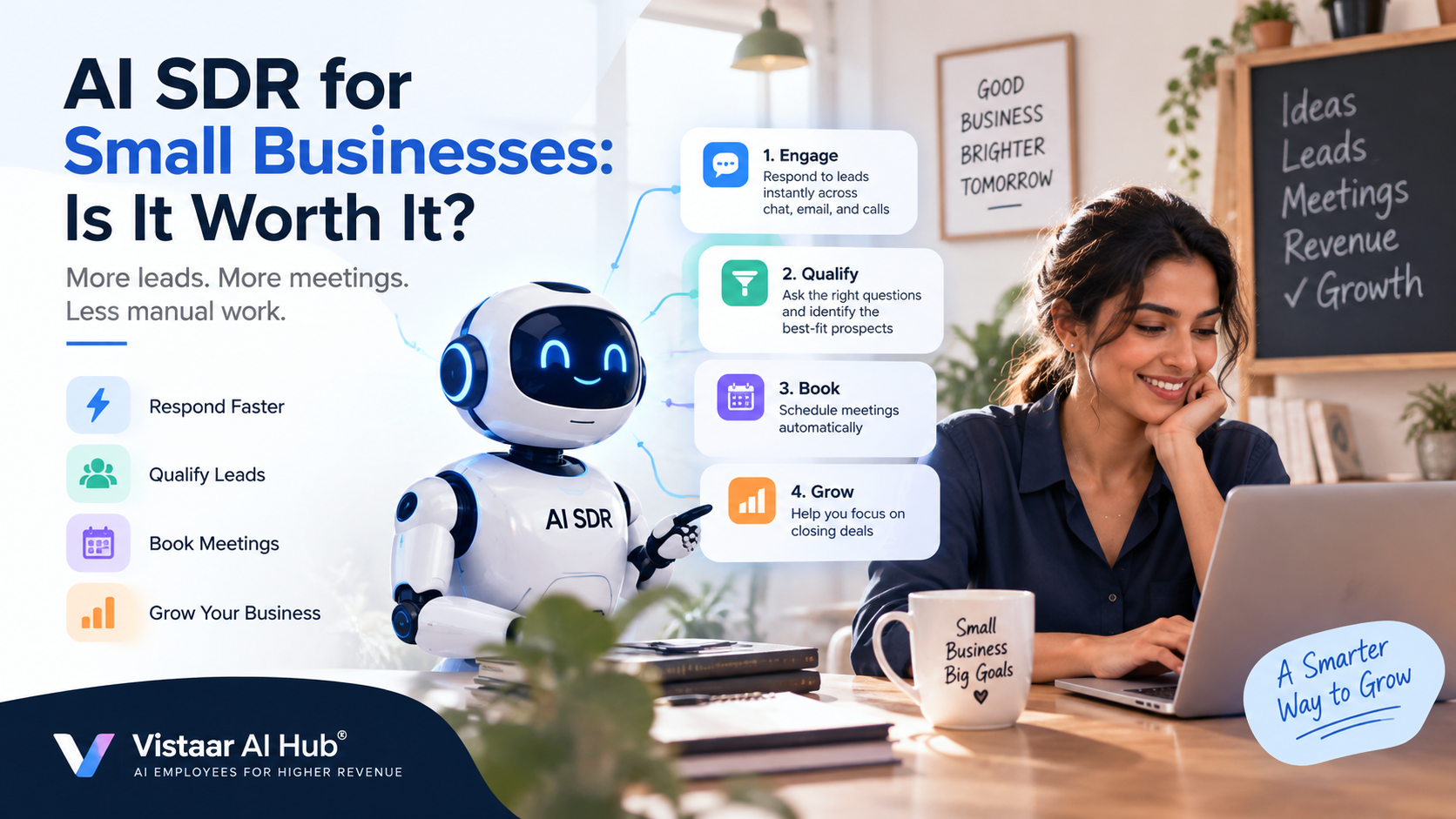
AI SDR for Small Businesses: Is It Worth It?
For a small business, every lead matters.
But when you're running a lean sales team, there is a common problem: you don't have enough people to respond to every lead, follow up consistently, qualify prospects, and book meetings.
Hiring a traditional Sales Development Representative (SDR) can help, but it also adds salary, training, management, and operational costs.
This is where AI SDRs are becoming an interesting option for small businesses.
An AI SDR can respond to prospects, ask qualification questions, follow up with leads, answer common questions, and schedule meetings automatically.
But the real question is:
Is an AI SDR actually worth it for a small business?
The answer depends on your lead volume, sales process, and how much repetitive work your team is currently doing.
What Is an AI SDR?
An AI SDR is an AI-powered sales agent that handles repetitive parts of the sales development process.
Instead of relying entirely on a human SDR to manage every initial interaction, an AI SDR can handle tasks such as:
- Responding to inbound leads
- Qualifying prospects
- Asking discovery questions
- Following up with leads
- Answering common sales questions
- Scheduling meetings
- Updating CRM information
- Re-engaging inactive leads
AI SDRs can operate across multiple channels, including voice, email, website chat, and messaging.
For a small business, this means you can potentially handle more sales conversations without immediately increasing your headcount.
Why Small Businesses Are Considering AI SDRs
Large companies can afford entire sales development teams.
Small businesses often can't.
A founder, salesperson, or small team may have to manage everything from prospecting and lead qualification to demos and closing.
That creates a problem.
A salesperson might spend several hours every day doing work like:
"What service are you looking for?"
"What's your budget?"
"When are you planning to get started?"
"Would Tuesday at 2 PM work for a meeting?"
These questions are necessary—but they don't necessarily require a salesperson's full attention.
An AI SDR can handle many of these repetitive interactions while the human team focuses on higher-value conversations.
5 Ways an AI SDR Can Help a Small Business
1. Respond to Leads Faster
Speed matters when someone shows interest.
Imagine a potential customer submits a form at 10 PM.
A traditional sales process might mean the lead waits until the next business day.
An AI SDR can respond immediately.
It can start the conversation, understand what the prospect needs, and potentially schedule a meeting without waiting for a salesperson to become available.
For businesses where prospects are comparing multiple providers, faster engagement can be a major advantage.
2. Qualify Leads Automatically
Not every lead is a good fit.
A small sales team doesn't want to spend 30 minutes talking to someone who doesn't have the budget, isn't in the target market, or has no immediate requirement.
An AI SDR can ask predefined qualification questions and collect important information.
For example:
Lead:
"I'm looking for an AI solution for my sales team."
AI SDR:
"How large is your sales team?"
Lead:
"About 25 people."
AI SDR:
"What are you primarily looking to automate?"
The AI can continue the conversation and determine whether the prospect matches the company's ideal customer profile.
The sales representative then receives a more qualified opportunity instead of an unfiltered lead.
3. Follow Up Without Manual Work
This may be one of the biggest advantages for small businesses.
A lot of potential deals are lost because nobody follows up consistently.
A salesperson may contact a prospect once, get a response like:
"I'll get back to you."
And then the lead gets forgotten.
An AI SDR can automate follow-ups based on the company's sales process.
For example:
Day 1: Initial conversation
Day 3: Follow-up
Day 7: Share relevant information
Day 14: Check if the prospect is still interested
If the prospect responds, the AI can continue the conversation.
If they book a meeting, the follow-up sequence can stop automatically.
4. Book Meetings Automatically
Getting a qualified lead is only half the job.
The next step is getting that lead into a sales conversation.
AI SDRs can connect with scheduling systems and offer available meeting times.
For example:
"We have availability tomorrow at 11 AM or Thursday at 3 PM. Which works better for you?"
The prospect chooses a time, and the meeting can be added to the calendar.
This removes the back-and-forth that often happens during scheduling.
5. Handle More Leads Without Hiring Immediately
Suppose a small business starts receiving 100, 200, or 500 inquiries per month.
The company may not want to hire additional salespeople immediately.
An AI SDR can help absorb some of that additional workload.
Instead of every lead requiring immediate human attention, the AI can:
Capture → Engage → Qualify → Follow Up → Book
The human sales team can then focus on the leads that actually need human involvement.
AI SDR vs. Hiring a Traditional SDR
The comparison isn't simply about replacing an employee with software.
It's about comparing how much repetitive sales work each approach can handle.
| Traditional SDR | AI SDR |
|---|---|
| Requires hiring | Can be deployed as software |
| Needs onboarding and training | Can be configured around your process |
| Works within human hours | Can operate 24/7 |
| Handles conversations sequentially | Can handle many conversations simultaneously |
| Manual follow-ups | Automated follow-ups |
| Manual scheduling | Automated scheduling |
| Human judgment | AI-driven qualification + human handoff |
| Best for complex sales conversations | Best for repetitive, high-volume interactions |
However, this doesn't mean AI SDRs are better at everything.
Human salespeople are still extremely valuable for relationship building, complex objections, negotiations, enterprise deals, and closing.
The strongest setup is often a combination of both.
When Is an AI SDR Worth It for a Small Business?
An AI SDR can make sense when your business has several of these characteristics:
You Receive Regular Leads
If your business receives only a handful of inquiries each month, an AI SDR may not provide enough value.
But if you're receiving leads every day, automating the initial sales process becomes much more attractive.
Your Leads Need Qualification
If salespeople spend significant time asking basic questions before determining whether someone is a good fit, AI automation can reduce that workload.
Your Team Is Missing Follow-Ups
If leads are frequently forgotten or contacted inconsistently, automated follow-up can have a meaningful impact.
Your Sales Process Is Repeatable
AI SDRs work particularly well when the initial sales process follows a relatively predictable pattern.
For example:
Lead → Qualification → Questions → Demo → Sales Call
The more repeatable the process, the easier it is to automate.
Your Sales Team Is Small
This is where AI SDRs can be particularly useful.
A team of two or three salespeople can use AI to handle repetitive interactions while they focus on the opportunities most likely to generate revenue.
When an AI SDR May Not Be Worth It
AI SDRs aren't the right solution for every business.
You may not need one if:
- You receive very few leads
- Every customer requires a highly customized sales process
- Your sales cycle depends heavily on personal relationships
- Most deals require extensive negotiation
- Your team already has more qualified leads than it can handle
- There isn't enough sales activity to justify automation
The goal shouldn't be to add AI simply because AI is popular.
The goal should be to remove a real bottleneck in your sales process.
How Much Work Can an AI SDR Actually Take Off Your Team?
Consider a simple example.
A small business receives 300 leads per month.
If a salesperson spends an average of 10 minutes on the initial qualification of each lead:
300 × 10 minutes = 3,000 minutes
That's approximately 50 hours every month spent on initial qualification alone.
If an AI SDR handles a significant portion of those conversations, the sales team can potentially redirect that time toward:
- Sales calls
- Product demonstrations
- Follow-ups with qualified prospects
- Negotiations
- Closing deals
- Customer relationships
The value isn't simply the number of hours saved.
It's what the sales team can do with those hours.
AI SDRs Can Be More Than Chatbots
One common misconception is that an AI SDR is simply a chatbot sitting on a website.
Modern AI sales agents can be designed to work across multiple touchpoints.
For example:
Website visitor
↓
AI chat conversation
↓
Lead qualification
↓
CRM update
↓
Meeting scheduling
↓
Email/SMS confirmation
↓
Human sales representative
The AI becomes part of the sales workflow rather than just another communication tool.
The Human + AI Sales Model
The most practical approach for many small businesses isn't:
AI OR humans
It's:
AI + humans
AI can handle:
- Initial engagement
- Basic questions
- Lead qualification
- Repetitive follow-ups
- Meeting scheduling
- Data collection
Humans can handle:
- Complex questions
- Product demonstrations
- Negotiations
- Relationship building
- High-value opportunities
- Closing
This creates a division of labor where each side focuses on what it does best.
How to Decide If Your Business Needs an AI SDR
Before investing in an AI SDR, ask yourself five questions:
1. How many leads do we receive every month?
More leads generally create more opportunities for automation.
2. How quickly do we respond?
If leads regularly wait hours before receiving a response, automation may help.
3. How much time do salespeople spend qualifying leads?
If qualification consumes a large portion of their day, there's a clear automation opportunity.
4. How often do we miss follow-ups?
If leads frequently go cold because nobody follows up, AI can help create consistency.
5. How many meetings could we generate if every qualified lead was followed up with?
This is perhaps the most important question.
The ROI of an AI SDR ultimately comes down to whether it can help create more qualified sales opportunities and revenue than it costs.
So, Is an AI SDR Worth It for Small Businesses?
For the right small business, yes.
But the value doesn't come from simply having an AI agent.
It comes from using AI to solve specific sales problems:
Slow response times
→ AI responds instantly
Too many unqualified leads
→ AI qualifies prospects
Missed follow-ups
→ AI follows up automatically
Scheduling back-and-forth
→ AI books meetings
Limited sales capacity
→ AI handles repetitive conversations
The businesses most likely to benefit are those with consistent lead volume, repetitive qualification processes, and small sales teams.
An AI SDR shouldn't replace the human side of sales.
Instead, it should make sure your salespeople spend less time on repetitive work—and more time talking to people who are actually ready to buy.