
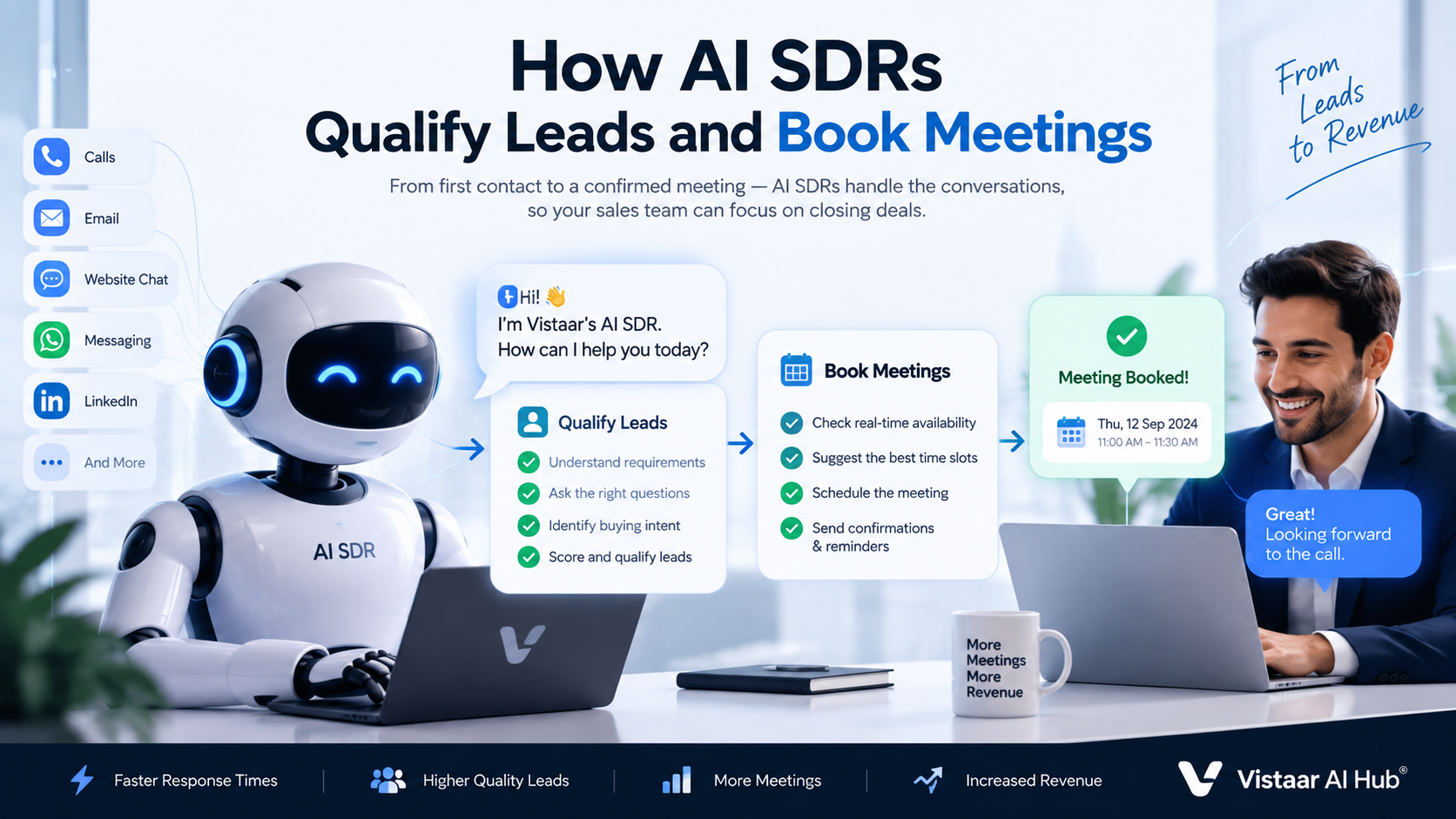
Sales teams spend a significant amount of time responding to leads, asking qualification questions, following up, and scheduling meetings. While these activities are essential for generating revenue, they can also take up valuable time that sales representatives could spend closing deals.
This is where AI SDRs (AI Sales Development Representatives) are changing the way businesses handle lead qualification and meeting booking.
AI SDRs use artificial intelligence to engage with prospects, understand their requirements, qualify them based on predefined criteria, and schedule meetings with the right sales representative—all without requiring a human to handle every interaction.
But how exactly does an AI SDR qualify a lead and turn that conversation into a booked meeting?
Let’s break down the process.
What Is an AI SDR?
An AI SDR is an AI-powered sales agent designed to automate parts of the sales development process.
Traditional SDRs typically spend their time:
Finding and contacting prospects
Responding to inbound leads
Asking qualification questions
Following up with prospects
Updating CRM records
Scheduling sales meetings
An AI SDR can automate many of these repetitive tasks while engaging prospects through channels such as voice calls, email, website chat, and messaging platforms.
The goal isn't simply to automate conversations. A good AI SDR should understand what a prospect wants, determine whether they are a suitable lead, and move qualified prospects toward the next sales step.
How AI SDRs Qualify Leads
Lead qualification is one of the most important stages of the sales process. Not every person who fills out a form, calls a business, or sends a message is ready to speak with sales.
AI SDRs can help identify which leads are worth pursuing.
1. AI Responds to the Lead
The first step is responding quickly.
When a prospect submits an inquiry, visits a website, sends a message, or calls a business, an AI SDR can engage with them almost immediately.
For example, imagine a software company receives an inquiry:
"I'm looking for a CRM for a sales team of around 50 people."
Instead of waiting for an SDR to become available, the AI agent can start the conversation immediately.
Fast responses are particularly useful for businesses where leads may contact multiple companies before making a decision.
2. AI Asks Qualification Questions
Once the conversation begins, the AI SDR can ask questions designed to understand the prospect.
Depending on the business, these questions could include:
What product or service are you looking for?
What problem are you trying to solve?
How many users or employees do you have?
What is your expected budget?
When are you planning to make a decision?
Are you currently using another solution?
Who is involved in the purchasing decision?
The questions can be adapted based on the prospect's responses rather than following a rigid script.
For example, if a prospect says they are already using a competing CRM, the AI SDR can ask what they would like to improve with their current system.
This creates a more natural qualification process.
3. AI Evaluates Lead Intent
Qualification isn't only about collecting information.
The AI SDR can analyze the conversation to understand the prospect's intent and buying readiness.
For example:
Low-intent lead:
"I'm just researching CRM options for next year."
High-intent lead:
"We're planning to replace our CRM this month. Can someone show us how your platform works?"
Both prospects are interested, but their buying intent is very different.
AI SDRs can use factors such as urgency, requirements, company information, budget, and responses during the conversation to determine where a lead sits in the sales funnel.
4. AI Scores or Categorizes the Lead
After collecting the relevant information, the AI SDR can categorize leads according to the company's qualification criteria.
For example:
| Lead Type | Example |
|---|---|
| Hot | Strong buying intent and immediate requirement |
| Warm | Good fit but needs more information |
| Cold | Low intent or early-stage research |
| Unqualified | Doesn't meet the company's target criteria |
Companies can define their own qualification rules.
For example, a B2B software company might prioritize companies with:
50+ employees
A dedicated sales team
A specific use case
A defined budget
A purchase timeline within 3 months
The AI SDR can use these criteria to determine whether a prospect should be passed to a human salesperson.
How AI SDRs Book Sales Meetings
Once a lead is qualified, the next challenge is getting the prospect onto the sales team's calendar.
This is another area where AI SDRs can significantly reduce manual work.
1. AI Identifies the Right Next Step
If the prospect is qualified and interested, the AI SDR can suggest a meeting.
For example:
"It sounds like our platform could help with your current sales workflow. Would you like to schedule a 20-minute demo with our sales team?"
If the prospect agrees, the AI can move directly to scheduling.
2. AI Checks Calendar Availability
Instead of asking a salesperson to manually coordinate times, the AI SDR can connect with the company's calendar or scheduling system.
It can identify available time slots and offer them to the prospect.
For example:
"We have availability tomorrow at 11:00 AM or Thursday at 3:00 PM. Which works better for you?"
The prospect chooses a time, and the meeting can be scheduled automatically.
3. AI Confirms the Appointment
After the meeting is booked, the AI SDR can provide confirmation details.
It can also send:
Meeting confirmation
Calendar invitation
Meeting link
Basic meeting information
Reminder messages
This reduces the chances of confusion and makes the handoff smoother.
AI SDRs Can Also Follow Up Automatically
One of the biggest problems in sales is inconsistent follow-up.
A salesperson may speak with a prospect today but forget to follow up next week. Another prospect may receive one email and never hear from the company again.
AI SDRs can automate these follow-ups.
For example:
Day 1: Initial conversation
Day 3: Follow-up message
Day 7: Additional information
Day 14: Final follow-up
The exact sequence can depend on the prospect's behavior.
If a prospect responds, the AI can continue the conversation. If they book a meeting, unnecessary follow-ups can stop automatically.
AI SDRs Don't Just Qualify Leads—They Contextualize Them
One of the biggest advantages of AI-driven qualification is that the sales representative can receive context before the meeting.
Instead of seeing only:
"Demo booked — John from ABC Company"
the salesperson could receive information such as:
Company: ABC Company
Team size: 50 employees
Current solution: Competitor X
Primary problem: Low lead response rate
Expected timeline: Within 30 days
Key requirement: Automated follow-ups
Meeting booked: Product demo
This gives the salesperson a much clearer picture of the prospect before the conversation begins.
The result is a more informed sales conversation.
AI SDR vs. Traditional SDR
AI SDRs don't necessarily replace human sales representatives. Instead, they can take over repetitive parts of the sales process so human SDRs and account executives can focus on higher-value conversations.
| Traditional SDR | AI SDR |
|---|---|
| Manually responds to leads | Can respond instantly |
| Repetitive qualification | Automated qualification |
| Manual follow-ups | Automated follow-up sequences |
| Manual scheduling | Automated scheduling |
| Limited working hours | Can operate 24/7 |
| Handles fewer conversations simultaneously | Can handle multiple conversations |
| Manually updates CRM | Can automate CRM updates |
The strongest sales teams may use both.
AI handles repetitive interactions and initial qualification, while human salespeople focus on complex objections, relationship building, negotiation, and closing.
Where AI SDRs Deliver the Most Value
AI SDRs can be particularly useful for businesses that receive a high volume of inquiries or have large numbers of prospects to engage.
Examples include:
SaaS Companies
AI SDRs can qualify demo requests, understand use cases, and schedule product demonstrations.
Real Estate
AI agents can respond to property inquiries, ask about budget and requirements, and schedule calls or property visits.
Recruitment
AI can engage candidates or clients, collect requirements, and schedule conversations with recruiters.
Financial Services
AI SDRs can handle initial inquiries, collect basic requirements, and route qualified prospects to the appropriate team.
Agencies and B2B Services
AI can qualify inbound leads based on company size, requirements, budget, and timeline before scheduling a consultation.
What Happens After a Meeting Is Booked?
Booking the meeting is not the end of the AI SDR workflow.
A well-designed AI sales system can continue supporting the process by:
Updating the CRM
Recording qualification information
Assigning the lead to the right salesperson
Sending meeting confirmations
Sending reminders
Tracking prospect responses
Triggering follow-ups when necessary
This creates a connected workflow from lead capture → qualification → meeting booking → CRM update → sales handoff.
The Future of AI SDRs
Sales development is moving from manual, repetitive workflows toward intelligent automation.
AI SDRs are becoming capable of handling conversations across multiple channels while using information from CRM systems, websites, calendars, and previous interactions to create more personalized experiences.
The biggest opportunity isn't simply reducing the number of tasks salespeople perform.
It is allowing sales teams to spend more time on the conversations that actually require human expertise.
Instead of having sales representatives spend hours asking basic qualification questions and coordinating calendars, AI can handle those steps and pass the right opportunities to the sales team.
Final Thoughts
AI SDRs are changing the traditional sales development workflow by combining lead engagement, qualification, follow-up, and meeting scheduling into a more automated process.
The process can be simple:
Engage → Understand → Qualify → Follow Up → Book → Handoff
For businesses dealing with large numbers of leads, the ability to respond quickly, qualify consistently, and book meetings automatically can make a significant difference to sales productivity.
The future of sales isn't necessarily AI versus human salespeople.
It's increasingly AI handling repetitive sales work while humans focus on closing and building relationships.