
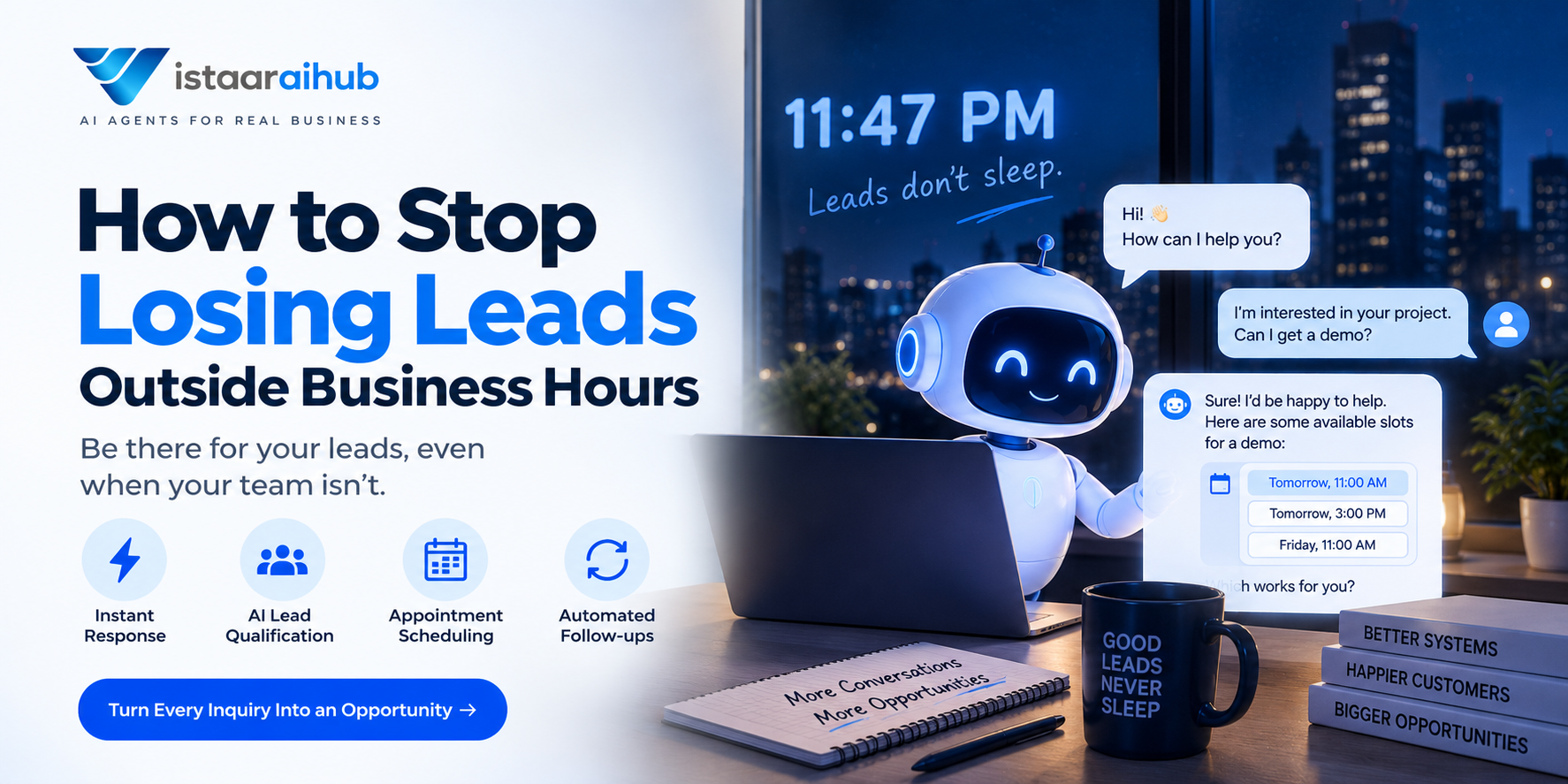
How to Stop Losing Leads Outside Business Hours
Imagine this.
A potential customer discovers your business at 10:47 PM.
They visit your website, fill out a form, ask a question on WhatsApp, or request a demo.
They’re interested right now.
But your sales team has already gone home.
So the lead waits.
Then morning comes. Your salesperson sees the notification at 9:30 AM, calls at 10:15 AM, and hears:
“Sorry, I already went with someone else.”
This happens more often than businesses realize.
The problem isn't always a lack of leads.
Sometimes, businesses are simply not available when their leads are ready to talk.
And that's exactly where businesses start losing revenue outside business hours.
Why Leads Don't Wait for Your Business Hours
Your customers don't operate according to your working hours.
They might be researching a property after work, comparing software late at night, looking for a financial service on the weekend, or submitting a request before their workday begins.
In today's digital buying journey, prospects can discover and contact a business 24/7.
But many sales teams still operate on a traditional schedule:
9 AM → 6 PM
That's a mismatch.
And every hour between your business closing and reopening can become a window where a competitor gets the opportunity to respond first.
The real issue isn't that your sales team isn't working at midnight.
They shouldn't have to.
The real issue is that there is no system handling the lead when your team isn't available.
What Happens to an After-Hours Lead?
Let's take a simple example.
A real estate company runs an ad for a ₹1.5 crore property.
At 11:20 PM, someone clicks the ad and submits:
“Interested. Can I schedule a site visit this weekend?”
The lead enters the CRM.
Nothing happens.
The salesperson sees it the next morning.
By then, the prospect may have:
- Contacted another developer
- Forgotten about the property
- Lost interest
- Stopped responding
- Booked a meeting with a competitor
The company technically generated the lead.
But it failed to capture the opportunity.
This is what makes after-hours lead leakage so expensive.
The First Response Matters
When someone submits a lead form, their interest is usually highest around that moment.
Think about your own behavior.
If you're actively looking for something and contact a company, you don't necessarily want a reply tomorrow.
You want an answer now.
This is particularly important for businesses with high-intent leads.
For example:
Real Estate
“Is this property available?”
SaaS
“Can I get a demo?”
Recruitment
“Are you hiring for this role?”
Financial Services
“Can someone explain this plan to me?”
These aren't random interactions.
They're buying signals.
The longer the business waits to respond, the greater the chance that the prospect moves on.
So, Should You Keep Salespeople Working 24/7?
No.
That's not the solution.
Hiring a night-shift sales team just to respond to occasional leads can become expensive and inefficient.
Instead, businesses need to separate two things:
Human sales conversations
from
Immediate lead response
Your salespeople should focus on conversations that actually require human judgment.
The initial response, qualification, information gathering, and scheduling can often be automated.
Build a 24/7 Lead Response System
A good after-hours system can work like this:
Step 1: Capture the lead
Someone fills out your website form, clicks an ad, sends a WhatsApp message, or requests a demo.
The lead immediately enters your CRM.
Step 2: Respond instantly
Instead of waiting until morning, an AI agent can acknowledge the inquiry.
For example:
“Hey! Thanks for reaching out. I can help you with that. Are you looking for a 2BHK or 3BHK?”
Now the conversation has started.
Step 3: Understand the lead
The AI can ask basic qualifying questions.
For example, a real estate business might ask:
- Which configuration are you looking for?
- What's your approximate budget?
- Which location are you interested in?
- Are you looking for self-use or investment?
- When are you planning to buy?
The objective isn't to replace the salesperson.
It's to make sure the salesperson receives context instead of a blank lead.
Step 4: Score the lead
Not every lead has the same level of intent.
Someone saying:
“Just exploring.”
is different from someone saying:
“I have a ₹1.5 crore budget and want to visit this weekend.”
Your system can categorize leads based on their responses.
For example:
Low intent
Just researching.
Medium intent
Actively comparing options.
High intent
Has budget + requirement + timeline.
Step 5: Book the meeting automatically
If the prospect is ready, don't make them wait for a salesperson to manually coordinate a time.
The system can offer available slots.
For example:
“Our sales consultant is available tomorrow at 11:30 AM or 3:00 PM. Which works better for you?”
The appointment gets added to the calendar.
Now your salesperson starts the day with a scheduled conversation, rather than a list of unanswered leads.
What About Leads That Aren't Ready Yet?
This is another place where businesses lose opportunities.
A lead might say:
“I'm planning to buy in 3 months.”
Most sales teams either forget about the lead or put a manual reminder somewhere.
That's risky.
Instead, the CRM should automatically create a follow-up workflow.
For example:
Day 0: Initial conversation
Day 7: Helpful follow-up
Day 30: Relevant update
Day 60: Check-in
Day 90: Sales follow-up
The exact cadence should depend on the buying cycle and customer preferences.
The important part is that the lead doesn't disappear simply because they aren't ready today.
Your CRM Shouldn't Just Store Leads
This is one of the biggest mistakes businesses make.
They treat their CRM like a database.
A CRM should answer:
“What should happen next with this lead?”
Instead of simply showing:
Lead: Rahul
it should show:
Rahul
- Interested in 3BHK
- Budget: ₹1.5 Cr
- Location: Gurgaon
- Intent: High
- Last conversation: Yesterday
- Site visit: Saturday, 11 AM
- Next action: Salesperson call
That's actionable information.
The Ideal After-Hours Lead Journey
Here's what the complete workflow can look like:
Lead comes in at 11:20 PM
↓
AI responds immediately
↓
AI understands the requirement
↓
AI qualifies the lead
↓
Lead is scored
↓
High-intent lead → Sales team
↓
Appointment booked
↓
CRM updated automatically
↓
Salesperson receives conversation history
↓
Salesperson starts the day with qualified opportunities
Meanwhile, lower-intent leads can enter automated nurturing.
This is how businesses can remain responsive without forcing humans to work 24/7.
Why This Matters Even More for High-Ticket Businesses
The economics are different when each lead can be worth thousands—or even millions—of rupees.
Suppose your company generates 1,000 leads per month.
If only a small percentage are genuinely high-intent, every missed high-intent conversation matters.
The goal shouldn't simply be:
“Generate more leads.”
It should be:
“Make sure the leads we're already paying for don't disappear.”
Because increasing ad spend doesn't fix a broken follow-up process.
You can generate 10,000 leads.
But if your team can't respond, qualify, follow up, and nurture them effectively, you're simply creating a bigger pile of missed opportunities.
The Future of Sales Isn't 24/7 Human Work
It's 24/7 availability + human expertise where it matters.
AI can handle repetitive parts of the sales process:
- Instant responses
- Basic qualification
- Lead scoring
- FAQs
- Follow-ups
- Appointment scheduling
- CRM updates
- Lead nurturing
Your sales team can then focus on:
- Complex objections
- Negotiations
- Consultative conversations
- Relationship building
- Closing deals
That's a much more scalable model.
Final Takeaway
If your business closes at 6 PM but your customers can contact you at 10 PM, your sales process cannot completely stop at 6 PM.
You don't necessarily need a bigger sales team.
You need a better system.
The goal isn't to make your salespeople work around the clock.
It's to make sure that when a prospect raises their hand, someone—or something—is there to respond.
Because a lead that comes in at 11 PM shouldn't have to wait until 10 AM to discover whether your business cares about their enquiry.
Your business hours may end at 6 PM.
Your lead response shouldn't.