
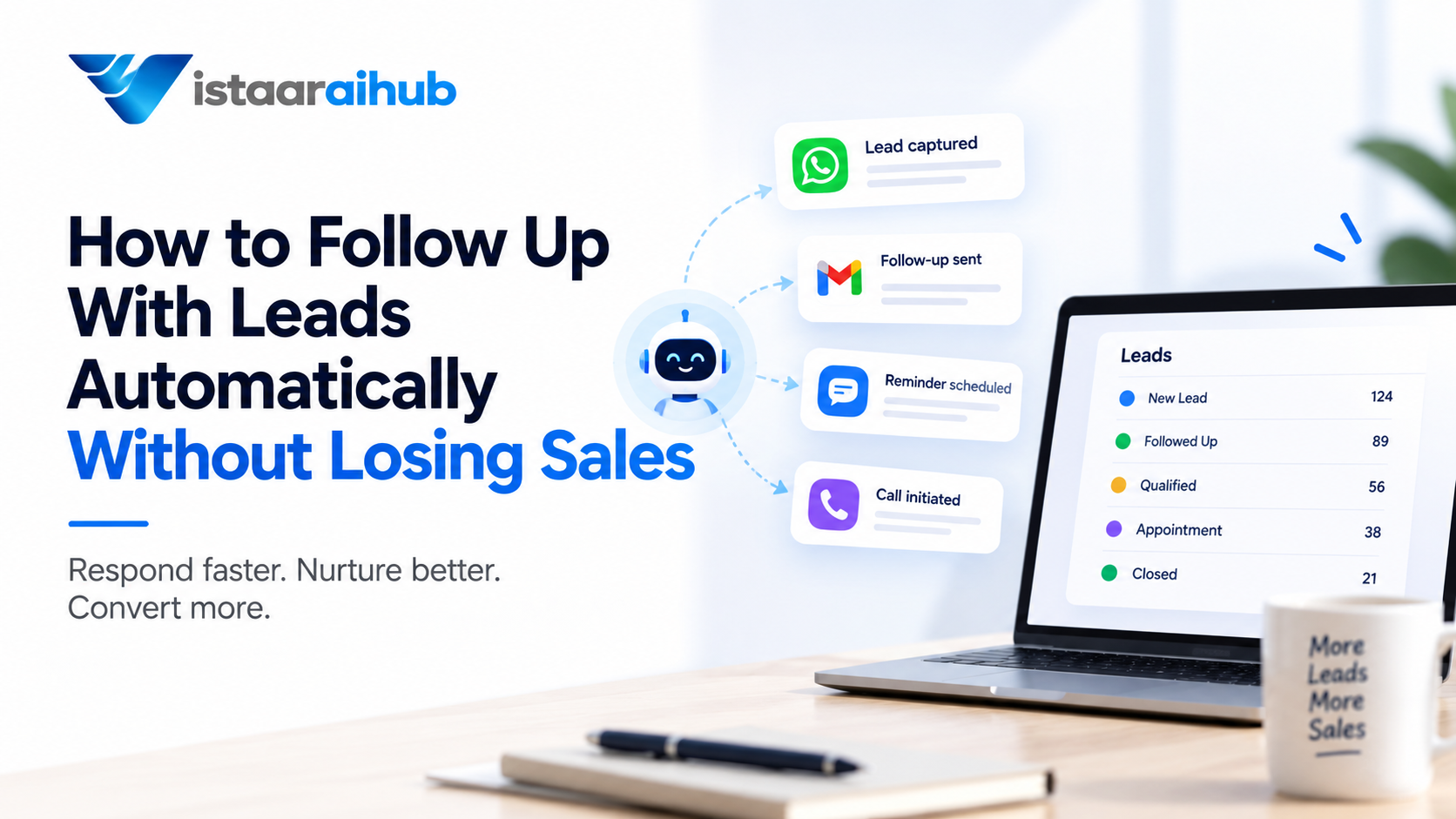
Sales Automation: How to Automate Lead Follow-Up and Nurturing
Sales automation helps businesses respond to leads faster, automate follow-ups, qualify prospects, nurture potential customers, and involve sales teams when leads are ready to buy.
Getting leads is only the beginning. The real challenge is following up consistently until a prospect is ready to take the next step.
A lead may submit a form today, reply to a WhatsApp message tomorrow, attend a demo next week, and make a purchase weeks later. If every follow-up depends on a salesperson remembering what to do next, opportunities can easily be missed.
This is where sales automation and AI-powered lead automation can help.
Instead of manually managing every interaction, businesses can automate repetitive sales activities while keeping human salespeople involved when their expertise matters most.
What Is Sales Automation?
Sales automation is the use of software, workflows, and AI to automate repetitive tasks throughout the sales process.
Depending on the business, this can include:
Capturing new leads
Sending instant responses
Qualifying prospects
Scoring leads
Following up with prospects
Nurturing cold and warm leads
Scheduling appointments
Updating CRM records
Assigning qualified leads to salespeople
Sending reminders
Tracking sales activities
A simple sales automation workflow might look like this:
Lead Captured → Instant Response → Qualification → Lead Scoring → Follow-Up → Appointment → Sales Handoff
The objective isn't simply to automate more tasks. The objective is to make the sales process more consistent and ensure that promising opportunities don't get forgotten.
Why Do Leads Go Cold?
Generating leads doesn't automatically generate sales.
Many prospects need multiple interactions before they are ready to buy. During that time, businesses often lose opportunities because follow-up isn't consistent.
Common problems include:
Slow responses to new leads
Missed follow-ups
Generic messages
Salespeople forgetting to call back
Leads getting lost in spreadsheets
Incomplete CRM information
No follow-up after a demo or meeting
Sales teams spending too much time on unqualified leads
No structured process for nurturing prospects
For example, someone might say:
"I'm interested, but I'll make a decision next month."
That doesn't necessarily mean the opportunity is lost.
The prospect may simply need more time.
Without a lead nurturing process, that person may never hear from the business again.
How Sales Automation Improves Lead Follow-Up
A well-designed sales automation system can handle repetitive follow-up activities while adapting the workflow based on the prospect's responses and behavior.
1. Respond to New Leads Immediately
When someone submits a form, requests information, starts a website chat, or enquires about a product, the first response can be automated.
For example:
New Lead → CRM → Instant WhatsApp/Email → Qualification
Instead of waiting for a salesperson to notice the new lead, the prospect can immediately receive an acknowledgement or the next qualification question.
Depending on the business, automated responses can be delivered through:
WhatsApp
Email
Website chat
SMS
Voice or calling systems
The exact workflow should depend on the customer's communication preferences and the business's consent and compliance requirements.
2. Automatically Qualify Leads
Not every lead requires the same level of sales attention.
Lead qualification helps businesses understand whether a prospect is a potential fit before assigning significant sales time to the opportunity.
An AI-powered qualification workflow can ask questions such as:
What product or service are you interested in?
What are you looking for?
What is your budget?
When are you planning to purchase?
Which location are you interested in?
What problem are you trying to solve?
The answers can then be used to categorize and score the lead.
For example:
High intent → Sales handoff
Medium intent → Nurturing
Low intent → Longer-term follow-up
This allows sales teams to spend more time on prospects that meet their qualification criteria.
3. Automate Personalized Lead Follow-Ups
Automation doesn't have to mean sending the same message to everyone.
A good lead follow-up automation workflow uses information from the lead and previous interactions to make communication more relevant.
For example, instead of:
"Hi, just following up."
A business could send:
"Hi Rahul, you mentioned that you're looking for a 3BHK property within your budget. We have two new options that may match your requirements. Would you like to schedule a site visit?"
The information used in the message can come from the prospect's previous conversation and CRM record.
This makes the follow-up more contextual without requiring a salesperson to manually write every message.
4. Follow Up Across Multiple Channels
Customers don't all communicate in the same way.
A sales automation workflow can connect different communication channels so businesses don't have to manage every interaction separately.
For example:
Website → WhatsApp → Email → Calling → CRM
A prospect might initially submit a website enquiry.
The system could then:
- Create the lead in the CRM.
- Send an acknowledgement.
- Ask qualification questions.
- Send a follow-up based on the response.
- Schedule an appointment.
- Update the CRM.
- Assign the lead to a salesperson when appropriate.
This creates a connected sales journey rather than a collection of disconnected conversations.
5. Use Lead Scoring to Prioritize Sales Opportunities
One of the most useful parts of sales automation is lead scoring.
Instead of treating every lead equally, businesses can assign scores based on factors such as:
Buying intent
Budget
Timeline
Product interest
Engagement
Qualification responses
Previous interactions
For example:
Lead Score: 85 → Sales-ready
Lead Score: 55 → Continue nurturing
Lead Score: 25 → Long-term follow-up
The actual scoring model should be customized for each business.
The purpose is to help the sales team understand which opportunities require attention now and which can continue through an automated nurturing process.
6. Know When to Involve a Human
Sales automation shouldn't mean removing humans from the sales process.
Some conversations are better handled by a salesperson.
For example, automation can manage the early stages:
Lead → Qualification → Nurturing → Scoring
Once a prospect reaches the business's qualification threshold:
Qualified Lead → Salesperson
The salesperson can then focus on activities such as:
- Product demonstrations
- Negotiations
- Complex questions
- Pricing discussions
- Contract discussions
- Closing
This creates a human + AI sales workflow rather than forcing either AI or humans to handle everything.
7. Keep Your CRM Updated Automatically
Manual CRM data entry can consume a significant amount of sales time.
When information is spread across WhatsApp conversations, emails, spreadsheets and call notes, it becomes difficult to understand the complete customer journey.
Sales automation can help capture information such as:
- Lead details
- Qualification responses
- Conversation history
- Lead score
- Follow-up status
- Appointment information
- Sales activities
- Next follow-up date
For example:
Customer replies → AI analyzes conversation → CRM updated → Lead score updated → Next action created
This reduces the number of repetitive administrative tasks salespeople need to perform manually.
What Is Lead Nurturing Automation?
Not every prospect is ready to buy immediately.
Lead nurturing automation is the process of maintaining relevant communication with prospects until they become more likely to take the next step.
Consider a prospect who says:
"I'm interested, but I'm not ready to buy yet."
Instead of repeatedly sending sales messages, an AI-powered workflow can move that prospect into a nurturing sequence.
The system might:
- Wait for an appropriate period
- Send relevant information
- Answer questions
- Monitor engagement
- Update the lead score
- Re-qualify the prospect
- Notify sales when buying intent increases
For example:
Interested → Not Ready → Nurturing → Increased Engagement → Re-qualification → Sales Handoff
This is where AI can make automated follow-up more flexible than a simple fixed reminder system.
Traditional Automation vs AI Sales Automation
Traditional automation typically works through predefined rules.
For example:
If a lead fills out a form → send Email A.
Or:
If there is no response for 3 days → send Reminder B.
These workflows can be useful, but they can become restrictive when customer conversations vary.
AI sales automation can add another layer of contextual understanding.
| Traditional Automation | AI Sales Automation |
|---|---|
| Rule-based triggers | Conversation-aware workflows |
| Fixed messages | Contextual responses |
| Fixed sequences | Adaptive follow-up |
| Manual qualification | AI-assisted qualification |
| Basic lead routing | Lead scoring and intelligent routing |
| Manual conversation analysis | AI-assisted conversation analysis |
The goal isn't to use AI everywhere.
The goal is to use AI where understanding customer conversations and deciding the next action can improve the workflow.
A Simple Sales Automation Workflow
A modern automated sales process can look like this:
For example, a prospect who is ready to purchase can move quickly to a salesperson, while someone who needs more time can remain in an automated nurturing workflow.
How AI Can Improve Automated Lead Follow-Up
Consider this conversation:
Customer: "I'm interested in your service, but I probably won't purchase until next month."
A basic automation system might simply send another sales message according to a fixed schedule.
An AI-powered system can use the conversation context to determine that the prospect isn't ready yet.
The workflow could instead:
Identify intent → Record the information → Adjust lead status → Start nurturing → Re-engage later
If the prospect later says:
"Can someone show me how this works?"
That change in intent can trigger another action:
Higher intent → Update lead score → Notify/assign salesperson
This is one of the key differences between simple task automation and more intelligent AI sales automation.
How VistaarAIHub Can Automate the Sales Process
VistaarAIHub is designed around the idea of connecting different parts of the sales process into one workflow.
A business can capture a lead and move it through:
Lead Capture → CRM → WhatsApp/Email → AI Qualification → Lead Scoring → Nurturing → Sales Handoff
An AI sales agent can help with the repetitive parts of the process, while the sales team can step in when a qualified prospect needs human interaction.
Depending on the workflow, businesses can use AI for:
- Lead qualification
- Lead nurturing
- Follow-up conversations
- Lead scoring
- CRM updates
- Appointment workflows
- Sales handoff
- Calling workflows
The result is a sales process where leads don't simply enter a CRM and wait for someone to follow up.
Benefits of Sales Automation
When implemented correctly, sales automation can help businesses create a more consistent sales process.
Key benefits include:
Faster lead response
New enquiries can receive an immediate response instead of waiting for manual action.
More consistent follow-up
Leads can continue through predefined or AI-assisted workflows without relying entirely on human reminders.
Better lead qualification
Salespeople can receive more context about a prospect before starting a sales conversation.
Less manual CRM work
Lead information and sales activities can be captured automatically where integrations support it.
More scalable sales operations
Businesses can manage a larger number of conversations without increasing every manual task at the same rate.
Better use of sales team time
Salespeople can focus more on qualified opportunities, complex conversations and closing.
Sales Automation Is More Than Sending Automated Messages
It's easy to think of sales automation as simply sending WhatsApp messages or scheduled emails.
But a complete sales automation system can connect the entire journey:
Capture → Respond → Qualify → Score → Nurture → Book → Update CRM → Handoff
The value comes from connecting these steps.
For example, sending an automated message without understanding the prospect's response doesn't create much intelligence.
But when the system can:
read the response → understand the requirement → update the lead → change the score → decide the next action
the workflow becomes significantly more useful.
Frequently Asked Questions
What is sales automation?
Sales automation is the use of software, workflows and AI to automate repetitive activities in the sales process, such as lead capture, follow-up, qualification, nurturing, scheduling and CRM updates.
What is lead automation?
Lead automation uses automated workflows to manage leads as they move through the sales funnel. It can include lead capture, qualification, scoring, follow-up, nurturing and sales assignment.
How do you automate lead follow-up?
You can automate lead follow-up by connecting your lead capture system with a CRM and communication channels such as WhatsApp, email or calling. The workflow can then send responses, qualify leads, schedule follow-ups and route qualified prospects to salespeople.
What is AI sales automation?
AI sales automation uses artificial intelligence to support sales workflows that require understanding customer conversations, qualifying prospects, personalizing communication, scoring leads and determining appropriate next actions.
Can AI automate lead qualification?
Yes. AI can ask predefined qualification questions, analyze responses and extract information such as requirements, budget, timeline and buying intent. Businesses can then use this information in their lead-scoring and sales-routing workflows.
Does sales automation replace salespeople?
Not necessarily. Sales automation is often used to handle repetitive activities while salespeople focus on complex conversations, negotiations, demonstrations and closing opportunities.
Final Thoughts
The biggest mistake businesses can make is treating follow-up as an individual task instead of building a repeatable sales system.
Getting a lead is only the first step.
A complete sales process needs to respond quickly, understand the prospect, qualify the opportunity, follow up consistently, nurture prospects that aren't ready, keep CRM information updated and involve a salesperson when human interaction is most valuable.
That's where sales automation, lead automation and AI sales agents can work together.
More leads don't necessarily solve a sales problem. A better process for managing those leads can make a significant difference.
If you're looking to automate lead qualification, follow-ups, nurturing, appointment workflows and CRM updates, VistaarAIHub can help you build an AI-powered sales workflow around your business.
Explore VistaarAIHub and see how AI sales automation can fit into your sales process.